Business Security Guard Services: The Hidden Cost of Going Without
An article by Bruce Thompson, Owner & Founder of ProTac Security | Central Coast, CA
Most business owners don’t think about business security guard services until something forces them to. It’s rarely a single dramatic event. More often, it’s a side door someone left propped open one too many times. A guard shift trimmed to save a few hundred dollars a month. A quiet assumption: “we’ve never had a problem here”, that eventually meets its exception.
By the time that happens, the cost of not acting has already outpaced what proper security services would have cost.
The Real Cost of Business Security Guard Services (vs. Going Without)
Security is one of the few line items business owners actively try to shrink. It’s understandable — on paper, it looks like pure overhead. No visible return, no revenue tied to it, just a recurring expense.
But that framing misses the actual math. A single theft, a liability claim, or one serious incident during a period with no coverage can cost more than a full year of proper security. And that’s before the damage that never shows up on a balance sheet: lost trust, reputational harm, higher insurance premiums, or a client relationship that quietly ends.
Security isn’t a cost center in the way it’s often treated. It’s closer to insurance that also happens to actively prevent the claim.
The Scale of the Problem
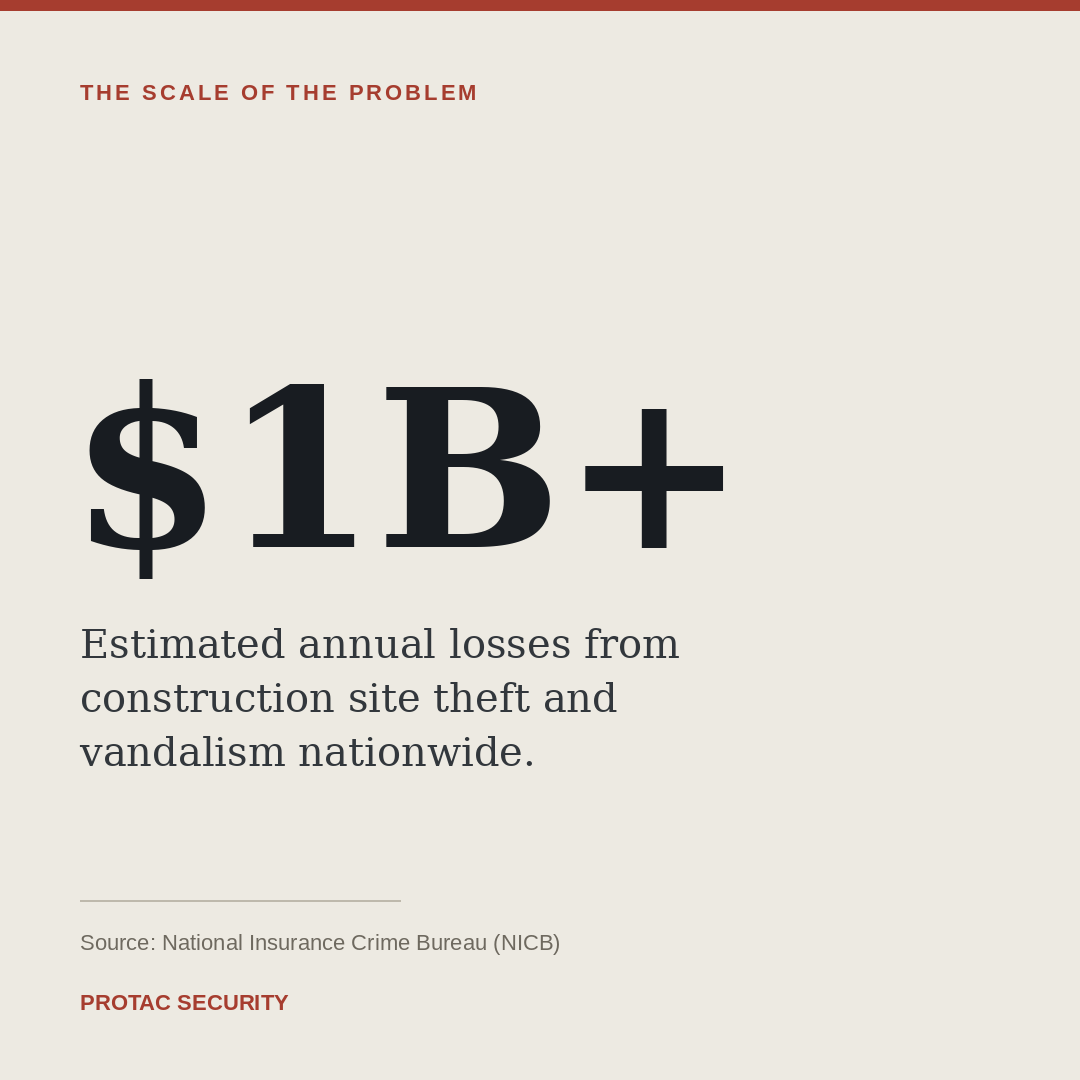
The numbers are larger than most owners expect. Construction sites alone account for over $1 billion in annual theft and vandalism losses nationwide — a figure the National Insurance Crime Bureau has tracked for years, and one that’s held steady rather than improved. Most of those incidents happen during the hours when no one is watching — nights, weekends, and holidays, when a site sits empty and predictable.
Predictability is the real vulnerability. Anyone casing a property for an easy target is looking for exactly that: a pattern with no variable in it. An unguarded site on a known schedule is, functionally, an invitation.
“We’ll Just Get Cameras”
This is the most common response, and it’s understandable — cameras are cheaper, they don’t call in sick, and they feel like a complete solution.
But cameras have one fundamental limitation: they record. Intervening isn’t something they can do. A camera can’t make the judgment call between someone loitering near an entrance at 2 AM and a legitimate late-night delivery, and it can’t de-escalate a confrontation or check credentials. Nor does it catch the small anomaly a trained eye notices right away — the parked car that’s been sitting too long, the door that’s ajar when it shouldn’t be, the person walking with purpose toward somewhere they don’t belong.
A camera records what already happened. A trained, present guard changes what happens in the first place.
The strongest security postures use both. One without the other leaves a real gap — and it’s usually the guard, not the camera, that gets cut first.
What Proper Coverage Actually Looks Like
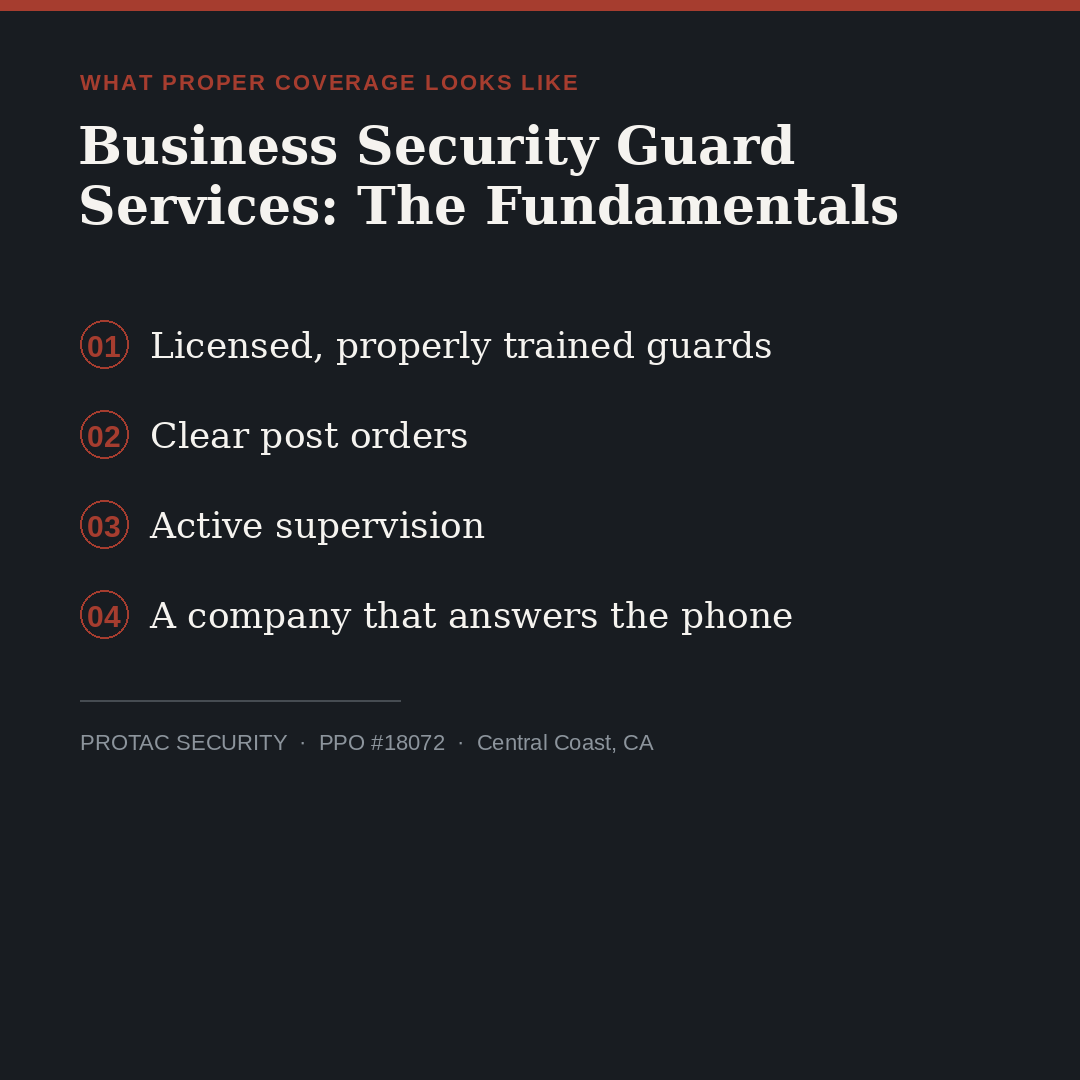
Effective business security guard services aren’t about headcount or hours logged. It comes down to a few fundamentals:
- Licensed, properly trained guards — not just a uniform, but someone who understands post orders, de-escalation, and when to call for backup versus when to intervene directly.
- Clear post orders — a guard who knows exactly what “normal” looks like on your property can spot what isn’t normal almost immediately.
- Active supervision — someone checking in, auditing performance, and catching problems before they become patterns.
- A company that actually answers the phone — not a call center reading from a script, but someone who knows your account and can make a real decision when something happens.
Most security failures aren’t failures of effort. They’re failures of structure — gaps in supervision, unclear expectations, or a guard who was never given the tools to do the job well.
Why Local Context Matters
The Central Coast isn’t one uniform risk profile. Farms in Santa Maria Valley face different exposure than a construction site in San Luis Obispo. A hospital needing controlled access faces different exposure still, and an event venue managing thousands of people has its own risks entirely.
Security that ignores a site’s specific realities — its traffic patterns, its hours, its layout, its history — is really just a guard standing somewhere. It’s not a strategy. The value comes from tailoring coverage to the actual risk, not applying a generic template to every account.
The Businesses That Wait
There’s a pattern worth naming honestly. Businesses that call after an incident almost always say the same thing: they assumed it wouldn’t happen to them. Businesses that call before an incident are, a year later, usually still glad they made the call — still without a story about the time something went wrong.
Both groups had the same odds going in. Only one group paid the lower price to find out.
What to Do Next
None of this requires an immediate overhaul or a long-term commitment. The most useful first step is an honest, no-pressure look at where your exposure actually is — not a sales pitch, just an assessment of the gaps and what closing them would realistically look like.
Don’t wait for the incident to find the gap for you.
ProTac Security Licensed Private Security Guard Company | PPO #18072 — verify our license Serving Santa Maria, San Luis Obispo, Santa Barbara, Lompoc, and the Central Coast since 2015 www.protacsecurity.com